start   back

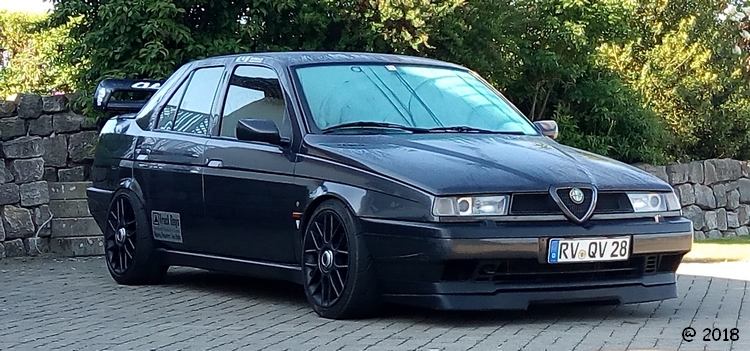
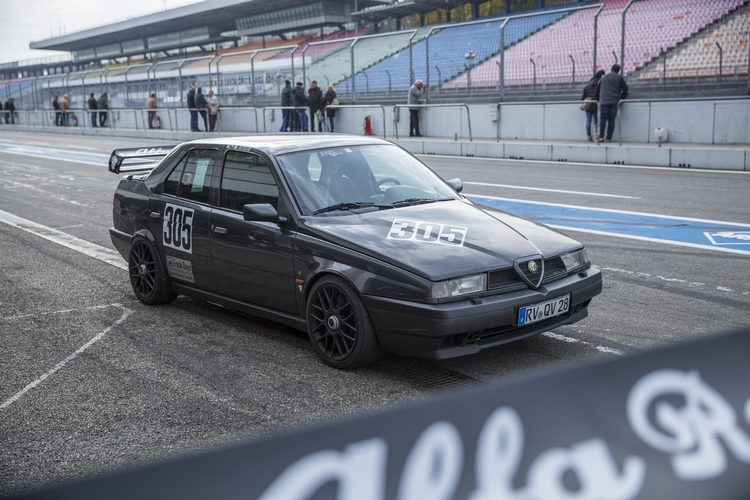
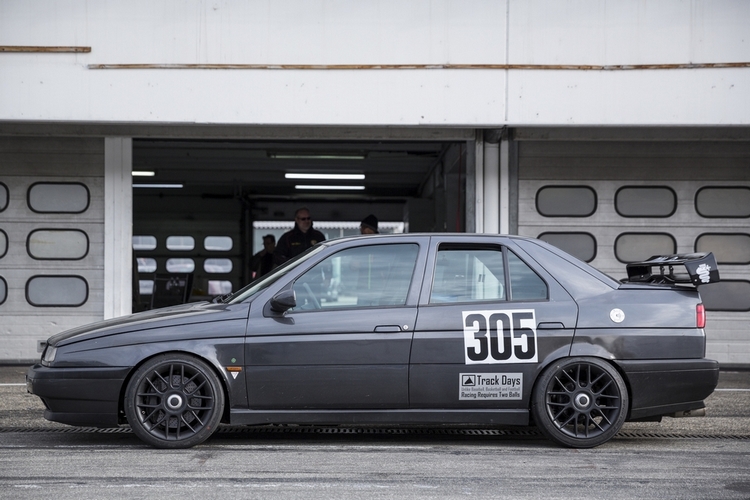
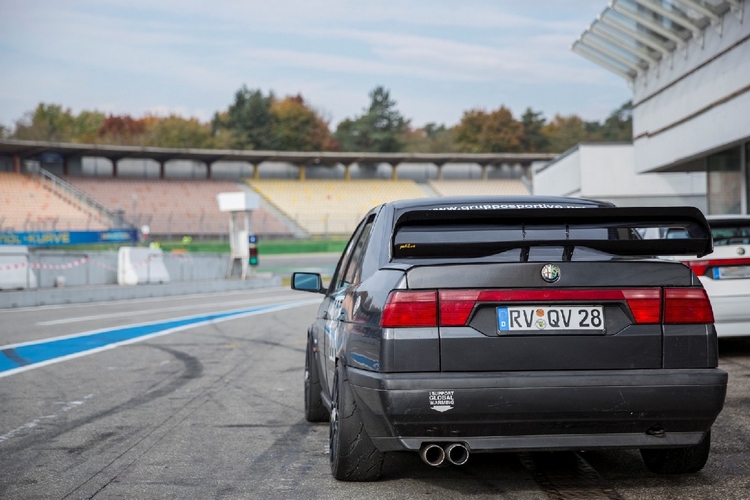
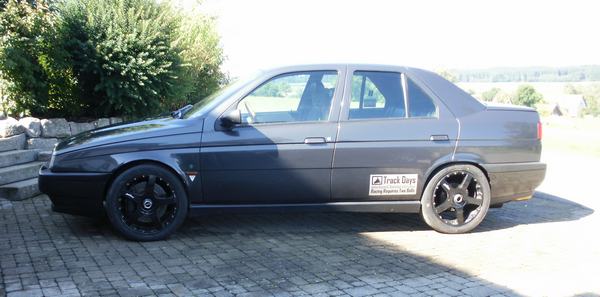
Alfa Romeo 155 3.0 24V


  3.0 24V
  240bhp
  250 km/h
  235/40-17
  OZ 8"x17"


In 2003 I bought an Alfa 155 V6 2.5 with a damaged cylinder head. At first I thought I would repair the original head, but since I had a 3.0-liter 24V engine sitting in the garage, I tossed aside my first plan because I realized that I should put the 3.0 in the 155!
In principle, the swap should be no problem, after all, the 3.0 block is the same as the 2.5 12V, only it has the 4 cam 24V heads.
To get an idea about placement and clearance, I pulled out the 2.5 and test-fit a 24V block. Fortunately I have a stripped block wich made this task much easily - I was pleased to find the block fit with no problem. If only the rest of the parts would fit so easily!
The first problem I saw was that the thermostat housing would have to be relocated to the gearbox side of the engine, whereas the 24V engine has the thermostat located on the belt side (more about this problem later).

Additionally, the test-fit revealed that there was no room for the serpentine belt to drive the ancillary compnents like A/C compressor, alternator, and power steering pump.


The above diagram at the left shows the belt configuration for the 155 V6 where the crankshaft drives two separate belts

The below left diagram shows how the 24V engine has a single serpentine belt driving all the ancillary components.

Another problem is that the placement of the alternator, PS pump, and A/C compressor is different between the two engines. Even though I had a varity of supports from Milano/75, a 155, and a156, nothing was compatible - so I ended up the stock A/C compressor mount from the 24V engine and fabricating supports for the steering pump and alternator.


This was not the end of the fitment problems though!
The inner fender and the front sub-frame both interfered with the ancillary set-up I had devised, so I was forced to mount the entire engine and transmission 15mm to the left. This required the fabrication of new engine mounts and modification of the drive shaft lengths.


Some notes about the thermostat housing:

Initially, I erroneously assumed I could both on a new waterpump cover to accommodate the transversale coolant hose. Unfortunally, the cap I had planned on using did not fit - and no such cover is available.
This required me to fabricate this part as well. I simply took a cap with an integral thermostat and hose coupling, and closed off the thermostat hole with a welded-on plate. I then recolated the thermostat to the gearbox side of the engine.


Source of this problem/modification will be the waterpump.
The block from 3.0 24V have different waterchannels, like other V6-blocks; also the 2.5 24V have usual channels, only the 3.0 24V is different.
On the right picture you can see above the waterpump from a 3.0 24V. All other V6-versions got the bottom-shown pump; but in various size (length of shafts).
The 3.024V waterpump/cap-flange has another bore/hole-scheme (the distance of screws), like mostly other. So I canīt grasp into shelves. This is the reason why I must modify one (above shown) cap.

That covers the majority of the major modifications that were required, but there were still a few issues to sort out:

After getting everything installed, the engine didnīt want start because the injectors did not get a signal from the Motronic 1.7 unit. After scrutinizing the wiring diagrams and scratching my head, I realized that the anti-theft mode was engaged. Needles to say, BOSCH could not provide assistance on how to defeat the anti-theft feature, but I eventually figured it out.

Finally I could drive the car - but not far because the engine kept overheating !

After I destroying three head gaskets I figured out the reason it was running hot - I couldnīt properly bleed the air from the reward cylinder head water channels because I had modified the external coolant hose routing. This caused an intermittent coolant flow to the rear cylinder head.


The yellow arrow in the picture points to a blocked-off passage that used to supply coolant to the heater core and also porvided for evacuation of air in the passages.
I solved the problem by installing a custom fitting shown by the red arrow.
Now the temperature is OK and the engine doesnīt overheat.

Lastly, the engine didnīt seem to be developing full power - it seemed down about 60-80 hp. At first I thought that the Motronic unit wasnīt reading the airflow properly with the open-element K&N filter - but it turned out that the placement of the intake was sucking in only hot under-hood air.
I moved the intake out into a cold air flow area and now
my 3.0 24V Alfa 155 "runs great".


If anybody want to do the same: a engine from a Alfa Romeo, Type 916 (GTV/Spider) will fit without any modifications.


start   back